Motorcycle winter storage in 6 steps: complete guide and checklist
Prepare your motorcycle for winter with six practical storage steps, fluid checks and a spring checklist. Protect the battery, fuel system, chain and tyres during the seasonal break.
Preparing your motorcycle for winter starts before the final ride of the season. Used oil, fuel left in the tank for months, a discharged battery and moisture can turn your first spring outing into a trip to the workshop. Careful preparation reduces these risks and helps keep your motorcycle in good condition throughout the break.
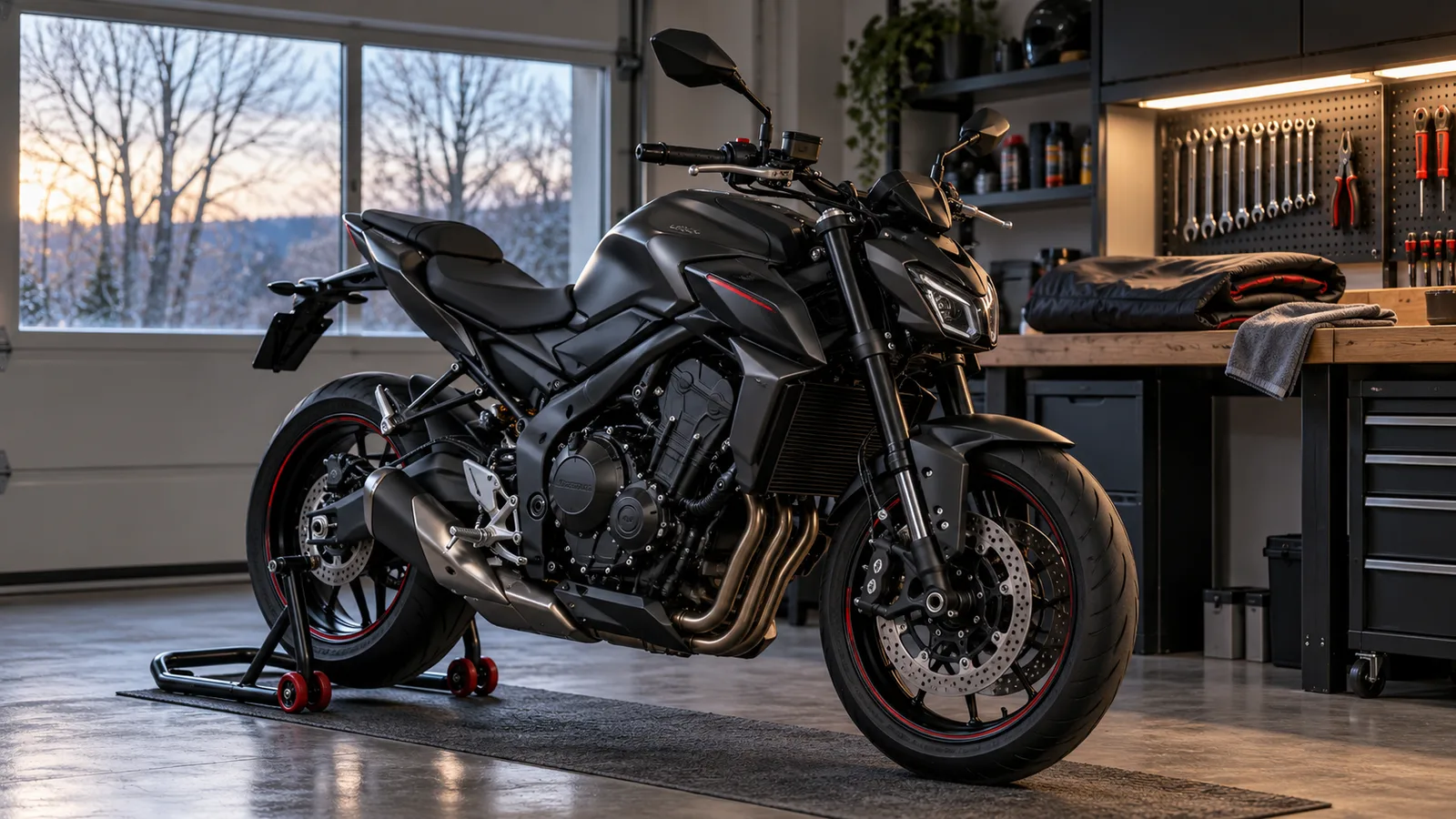
A dry space and a clean motorcycle are the starting point for winter storage. Illustrative image.
This guide covers six steps for winter motorcycle storage, coolant and brake fluid checks, common mistakes and a checklist for getting back on the road. Adapt the advice to your model, battery type and storage conditions: the motorcycle owner’s manual and product instructions take priority.
Winter motorcycle preparation at a glance
- Check the service schedule and change the oil and filter if needed.
- Prepare the fuel for storage.
- Protect the battery with a compatible charging method.
- Wash, dry and lubricate the motorcycle.
- Check tyre pressure and support the motorcycle securely.
- Choose a dry storage space and a cover that lets moisture escape.
1. Oil and filter: check the service schedule before storage
During use, oil can accumulate combustion by-products, moisture and fuel, and its properties change. If a service is due or approaching, it makes sense to carry it out before winter storage so the engine does not sit for months with degraded oil.
Replace the filter according to the maintenance schedule and use the quantity, viscosity and specifications required by the manufacturer. If the oil was changed recently, do not assume another change is necessary simply because autumn has arrived: check the service history and your model’s storage instructions.
Why does the motorcycle oil specification matter?
On many four-stroke motorcycles, the engine, gearbox and wet clutch share the same oil. These models may require JASO MA or MA2. Do not choose a car engine oil solely by viscosity or price: certain friction modifiers may be incompatible with a wet clutch. Other engines and some scooters have different requirements.
Browse our motorcycle oils and maintenance products and compare their specifications with your owner’s manual before choosing.
Get your motorcycle ready for winter storage
Find engine oils and chain-care products at Roataway. Check your owner’s manual and choose maintenance supplies that match your motorcycle.
Motorcycle engine oils · Chain care · All maintenance products

Motul 7100 4T 10W-40: an example from our motorcycle oil range. Choose the viscosity and specifications required by your motorcycle.
2. The fuel tank and petrol stabiliser
Petrol can deteriorate during storage and form deposits in the fuel system. In metal tanks, reducing the air space can help limit condensation. If the manual recommends storing the motorcycle with a full tank, fill it with fresh petrol to the permitted level, leaving the necessary expansion space.
Choose a stabiliser compatible with your petrol and the intended storage period. Follow the dosage on the label; more is not automatically better. A stabiliser helps preserve fresh fuel but does not restore petrol that has already deteriorated.
The additive needs to circulate through the fuel system
For AMSOIL Gasoline Stabilizer, the manufacturer’s data sheet specifies running the engine for 5–10 minutes after adding it to distribute the mixture. You can incorporate this into your last ride of the season if weather and road conditions allow. Never run the engine in an enclosed garage.
Dosage example for AMSOIL Gasoline Stabilizer only: approximately 31 ml for 10 litres, 47 ml for 15 litres or 63 ml for 20 litres of petrol. These amounts correspond to roughly 3.1 ml per litre; a 473 ml bottle treats about 150 litres. Check the label on the version you buy. These quantities do not automatically apply to other additives.
For carburetted motorcycles, the manual may call for draining the float bowls. Follow the procedure for your model, as preparing a carburettor may differ from preparing a fuel-injection system.
3. The battery: use the right charging method
A battery gradually loses charge during storage, and alarms or other circuits may continue to draw power. Leaving a lead-acid battery discharged for a long period encourages sulphation and loss of capacity.
- Use a maintenance charger compatible with your battery technology: conventional lead-acid, AGM, gel or lithium.
- Leave the charger connected continuously only if both the battery and charger manufacturers permit it.
- If you remove the battery, follow the motorcycle’s procedure and store it in a dry place within the manufacturer’s specified temperature range.
- Check the state of charge regularly. Recharging intervals depend on the battery and storage conditions.
Do not automatically apply a lead-acid battery procedure to a lithium battery. Desulphation modes and charging at low temperatures may have specific restrictions.
4. Washing, drying, chain care and corrosion protection
Remove mud, insects and road salt before storage. Use products suitable for each surface and avoid directing a powerful water jet at bearings, seals or connectors. Dry the motorcycle carefully, including places where water can collect, before fitting the cover.
Clean and lubricate the chain with products compatible with its type, including O-ring or X-ring seals. Check the chain slack according to the manual. A dirty, unprotected chain can develop corrosion and stiff links.
You can apply a compatible corrosion-protection product to exposed metal surfaces. Do not spray brake discs, brake pads, tyres or contact surfaces. The exhaust must be cold, and the product must be applied according to its label.
For very long storage or high humidity, internal protection with a preservative known as fogging oil should only be used if the procedure is suitable for the engine. If it is not described in the manual, ask a workshop for guidance.

IPONE X-TREM Chain Road: an example of chain lubricant. Check the instructions and compatibility before use.
5. Tyres: correct pressure and stable support
Measure tyre pressure when cold and adjust it according to the motorcycle manufacturer’s storage recommendations. The maximum pressure printed on the sidewall is not automatically the correct pressure for your motorcycle. Also check for cracks, deformation, cuts and air leaks.
If you have compatible stands and can use them safely, take the load off the wheels following the equipment instructions. If the motorcycle remains on its tyres, check the pressure regularly and occasionally change the contact patch by moving the bike carefully.
Before replacing a tyre, check the size, load and speed ratings, and rim compatibility. Our guides to reading tyre sizes and tubeless versus tube-type tyres help explain the markings.
6. Storage space and a motorcycle cover
Choose a dry, ventilated location protected from the weather and large temperature fluctuations. Cover the motorcycle only when it is clean, dry and cool. A suitable cover lets moisture escape; plastic sheeting resting against the motorcycle can encourage condensation.
If rodents could enter the exhaust, protect the outlet with a suitable plug or an easily removable cover, but only after it has cooled. Attach a clearly visible reminder to the handlebars: “Remove the exhaust cover before starting.” Do not push material deep into the exhaust.
Coolant and brake fluid: checks that depend on more than mileage
Coolant
On liquid-cooled engines, check the coolant level, freeze protection and replacement interval. Coolant also protects against corrosion, and its additives have a limited service life. Deposits, cloudiness or an unusual change in colour warrant an inspection.
Use the formulation required by the manufacturer. Ready-mixed coolant is used as supplied; concentrate must be mixed only in the specified proportion and with the specified water, usually demineralised. Do not mix coolants simply because they have the same colour, and do not open the cooling system while the engine is hot.
Brake fluid and hydraulic clutches
DOT 3, DOT 4 and DOT 5.1 brake fluids absorb moisture over time. Water lowers the boiling point, which can affect braking under heavy use. Clear-looking fluid is not proof that it is still within its service interval.
Follow the replacement interval and fluid grade in the manual, using fluid from a container stored according to the manufacturer’s instructions. Silicone-based DOT 5 is not the same as DOT 5.1. For a hydraulic clutch, check the specified fluid separately: some systems use mineral oil rather than brake fluid. Have a workshop replace and bleed the fluid if you lack the necessary experience and equipment.
Maintenance intervals: guide values to check against your manual
- Oil and filter: the manufacturer’s mileage or time limit, whichever comes first. One year is a common reference point, not a universal rule.
- Coolant: the source guide uses two years as a reference; long-life formulations and some models may have different intervals.
- Brake fluid: two years is a common reference point. Track use may require more frequent changes, depending on the system and fluid.
- Hydraulic clutch: check the fluid type and replacement interval separately in the manual.
- Chain: inspect and lubricate before storage. Adapt the guide’s 500–800 km reference to the manual, rain, washing and riding conditions.
- Fuel and battery: prepare before storage and check according to the instructions for the products used.
Why short periods of idling do not replace maintenance
Repeatedly starting the engine for a few minutes during winter may not heat the oil and exhaust enough to remove moisture. A short period of idling may also fail to replace the energy used to start the engine.
A motorcycle prepared for storage does not need to be started periodically just to keep it running. If you ride in winter, allow the motorcycle to warm up fully and make sure road conditions are safe. The 20–30 minutes mentioned in the guide is an indication, not a guarantee for every engine and temperature. A compatible charger is the appropriate way to maintain the battery during storage.
Products in the source guide: examples to check for compatibility
The source guide mentions AMSOIL Gasoline Stabilizer and Quickshot for fuel; AMSOIL Powersports Coolant, IPONE Radiator Liquid and Motul Motocool for cooling; and AMSOIL DOT 3 and DOT 4, DOMINATOR DOT 4 Racing, Motul DOT 5.1, RBF 600 and RBF 660 for braking.
Cleaning and preservation examples include AMSOIL MP Metal Protector, Engine Fogging Oil, Miracle Wash and IPONE X-TREM Chain Road. These products have different purposes and requirements. Check each product’s current data sheet, dosage, protection period and compatibility; do not assume all listed brake fluids have the same DOT grade or that every additive suits a full winter of storage.
Spring checklist: before your first ride
- Remove the exhaust cover and any other storage protection.
- Check the battery, connections and mounting.
- Measure cold tyre pressures and inspect the tread and sidewalls.
- Check the oil level and look for leaks.
- Check the coolant level, condition and age where applicable.
- Inspect the brake fluid, pads, discs and operation of the controls.
- Check chain slack and lubrication.
- Test the lights, indicators and horn.
- Start the engine according to the manual and avoid heavy loads while it is cold.
- Test both brakes at low speed in a safe place before entering traffic.
Prepare your maintenance supplies before the seasonal break. Explore motorcycle oils and maintenance products at Roataway. For product information, contact the Roataway team with the make, model, year and specifications from your manual.
FAQ
Should I change the oil before winter or in spring?
If a service is due or approaching, change the oil and filter before storage. If the oil was changed recently, check the service history and your model’s instructions. Follow the manufacturer’s time or mileage limit.
Should I start my motorcycle regularly during winter?
Short periods of idling can encourage moisture accumulation and may not recharge the battery sufficiently. For a motorcycle prepared for storage, follow the owner’s manual and maintain the battery with a compatible charger.
What tyre pressure should I use when storing my motorcycle?
Use the cold tyre pressure recommended by the motorcycle manufacturer for the relevant conditions. Do not automatically inflate to the maximum on the sidewall. Check pressure regularly and, if the wheels remain on the ground, move the motorcycle to change the contact patch.
Do I need a petrol stabiliser for winter storage?
For a break of several months, a compatible stabiliser can help keep fresh petrol in good condition. Check the manual and product label, follow the dosage and circulate the mixture through the fuel system before storage.
Can I leave the battery connected to a charger all winter?
Only if it is a compatible maintenance charger and both the battery and charger instructions allow continuous connection. Lead-acid, AGM, gel and lithium batteries may require different charging modes and conditions.